
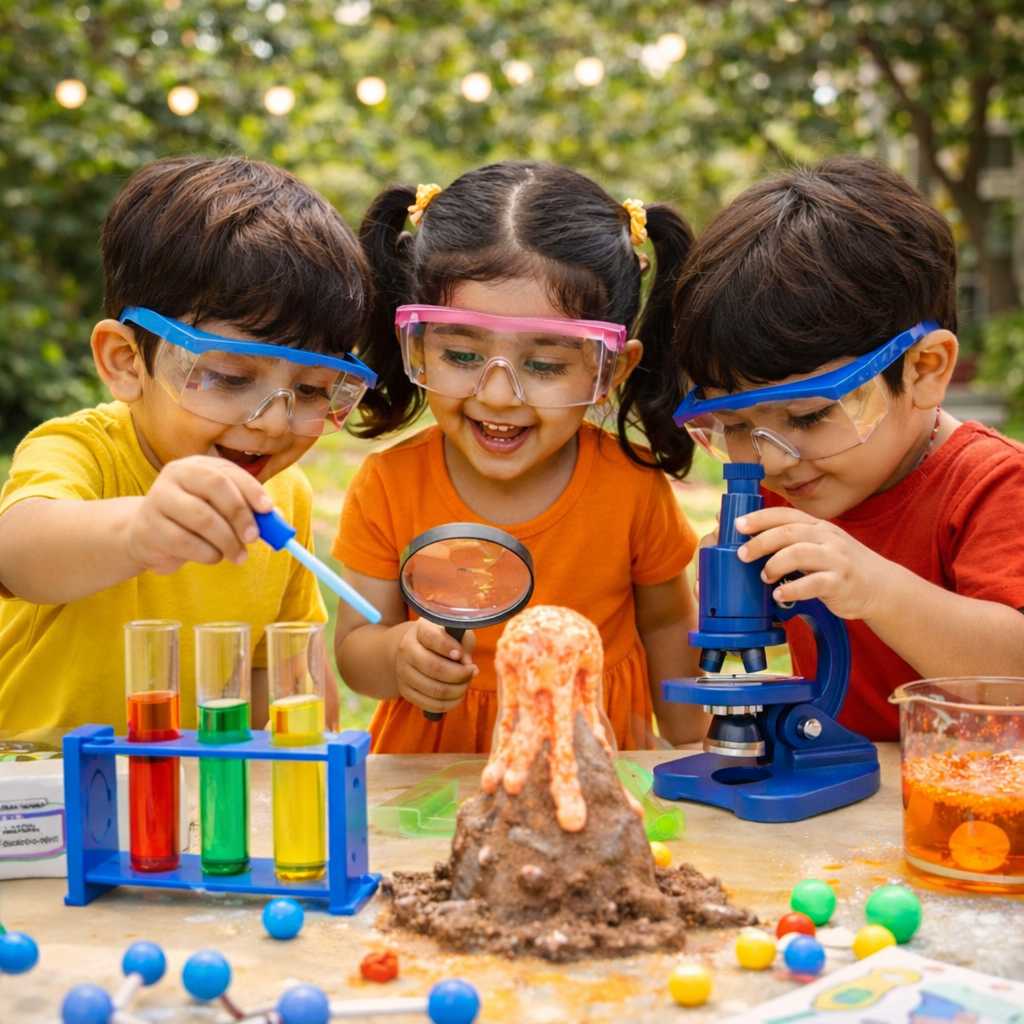
“Where wonder sparks, questions grow, and little minds discover the world.”
A Classroom Full of Curiosity
The classroom buzzes with anticipation. On one table, children watch a small paper boat float in water, on another, colorful liquids mix and change before their eyes. Some children gently touch leaves, examining textures, while others drop ice cubes into bowls to observe melting patterns. Every corner is alive with questions, laughter, and “Wow!” moments. Today, science is hands-on, sensory, and exciting—far from textbooks.The teacher kneels beside a group, asking, “What do you think will happen if we add vinegar to baking soda?” Little faces light up as the fizzy reaction surprises them. These moments turn curiosity into real learning, where children become investigators and nature itself becomes the teacher.
Why Early Science Matters
Introducing scientific exploration at a young age builds skills that go far beyond experiments. When children engage hands-on, they:
- Develop Observation Skills: By watching how objects float, how colors mix, or how plants grow, children learn to notice details, recognize patterns, and make sense of changes around them.
- Strengthen Critical Thinking: Making predictions, testing ideas, and reflecting on outcomes encourages logical reasoning and helps children understand cause-and-effect relationships.
- Enhance Problem-Solving Abilities: Experiments present challenges. Children figure out solutions, experiment with different approaches, and learn to handle setbacks, which builds resilience.
- Grow Language and Communication Skills: Explaining their observations, describing what they see, and discussing results introduces new vocabulary and helps children express ideas clearly.
Boost Confidence and Independence: Successfully conducting experiments fosters a sense of achievement, motivating children to explore, question, and take initiative in learning.
How We Make Learning Science Fun at School
At our school, we turn curiosity into structured exploration. Each experiment is designed to allow children to observe, hypothesize, test, and discuss results, making learning hands-on and reflective. From experimenting with floating and sinking objects to mixing colors or observing plant growth, every activity encourages children to ask questions and try different approaches. Teachers guide them gently, prompting them to predict outcomes, compare results, and draw conclusions, fostering critical thinking and problem-solving. By combining play, experimentation, and thoughtful discussion, we ensure science is not just observed—it is experienced, understood, and enjoyed, laying the foundation for lifelong curiosity.
Little Scientists at Home
Parents can foster curiosity at home with easy activities:
- Observe the sky or weather daily and note changes
- Experiment with kitchen science (dissolving sugar, vinegar-baking soda)
- Grow a small plant and track its progress
- Collect leaves, stones, or shells to sort and classify
Ask open-ended questions: “Why do you think this happens?”
Discovery, Wonder, and Joy
Science doesn’t have to be complicated. With simple experiments, children develop critical thinking, observation skills, and curiosity while having fun. When teachers and parents guide exploration together, every fizz, float, and color change becomes a step toward confident, inquisitive learners.